How to read your appraisal notice
Use the sample notice to locate the values, filing instructions, and exemptions on your own paperwork. Have your notice beside you as you work through the six stages.
1. Identify your notice and its values
Check the notice date and property ID. Locate the market value, net appraised value, and the values assigned to each taxing unit. This is a notice of the district’s appraisal. Your tax bill comes separately.
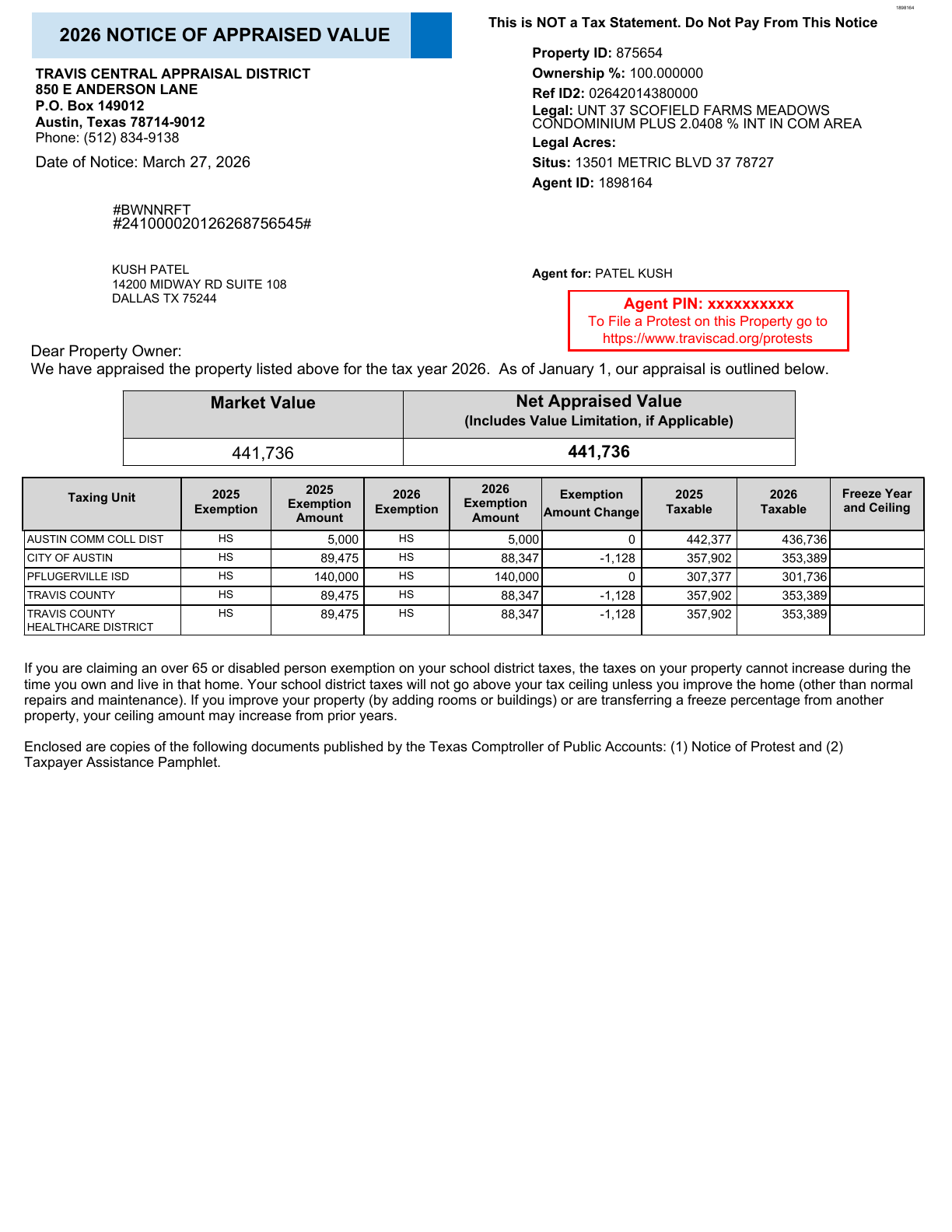
The sample image could not open. Use the numbered field explanations on this page or open sample page 1 on kush.law.

Fields on this page
Select a numbered field to read its explanation.
1. Market Value
The appraisal district's total-value conclusion as of January 1, before exemptions or unit-specific adjustments change how the notice continues.
Market value is the district's opinion of what the property would have sold for on January 1 of the tax year.
It is the valuation anchor for the notice, but it is not the last number that will appear in the packet.
The rest of the notice explains whether limitations, exemptions, or taxing-unit treatment cause later lines to diverge from that starting point.
- Start the review here, not with the later component lines.
- Market value can lawfully differ from appraised or taxable value.
- If the total value conclusion looks unsupported, this is the line most owners are actually contesting.
Sample notice, page 1 · Texas Tax Code § 23.01 · Texas Tax Code § 25.19
2. Net Appraised Value
A tax-use value that may track market value exactly or diverge from it when a statutory limitation applies.
Net appraised value starts from market value, but the notice may substitute a lower number when a statutory limitation applies.
That is why two lines on the same page can both be correct even when they do not match.
The question is not merely whether the numbers differ. The question is whether the notice gives a lawful reason for the difference.
- Do not assume a mismatch is arithmetic error.
- Check for a homestead or circuit-breaker limitation before drawing conclusions.
- Net appraised value can still be reduced further when exemptions are applied by taxing unit.
Sample notice, page 1 · Sample notice, page 2 · Texas Tax Code § 23.23
3. Taxing Units
Each row is a separate taxing authority, and each can reach a different taxable-value outcome from the same notice.
The table does not merely repeat the same number for different governments. It shows how the same property is treated across distinct taxing authorities.
Each unit may honor exemptions differently or apply different reduced values for tax purposes.
That is why the notice needs a row-by-row reading instead of a single-value assumption.
- Read every row as its own tax-use context.
- Uniform market value does not guarantee uniform taxable value.
- Most notice confusion disappears once the table is read unit by unit.
Sample notice, page 1 · Texas Comptroller · Property taxpayers’ bill of rights
4. Taxable Value
The amount each taxing unit may actually use after exemptions and other allowed reductions are applied.
Taxable value is usually derived after the notice applies exemptions to the relevant appraised value line.
Because units do not all honor the same exemptions in the same amount, the notice can show multiple taxable values for the same property.
That multiplicity is a feature of the form, not necessarily a defect in the notice.
- Taxable value is commonly lower than market value.
- Exemption effects often appear here, not on the headline market value line.
- Read taxable value by unit, not as a single property-wide number.
Sample notice, page 1 · Sample notice, page 2 · Texas Comptroller · Property taxpayers’ bill of rights
Sample notice, page 1 · Texas Tax Code § 25.19 · Texas Comptroller · Property tax bills
2. Read the value breakdown
Find the total market value before looking at the land and improvement lines. Then check whether a limitation accounts for a difference between market value and net appraised value.
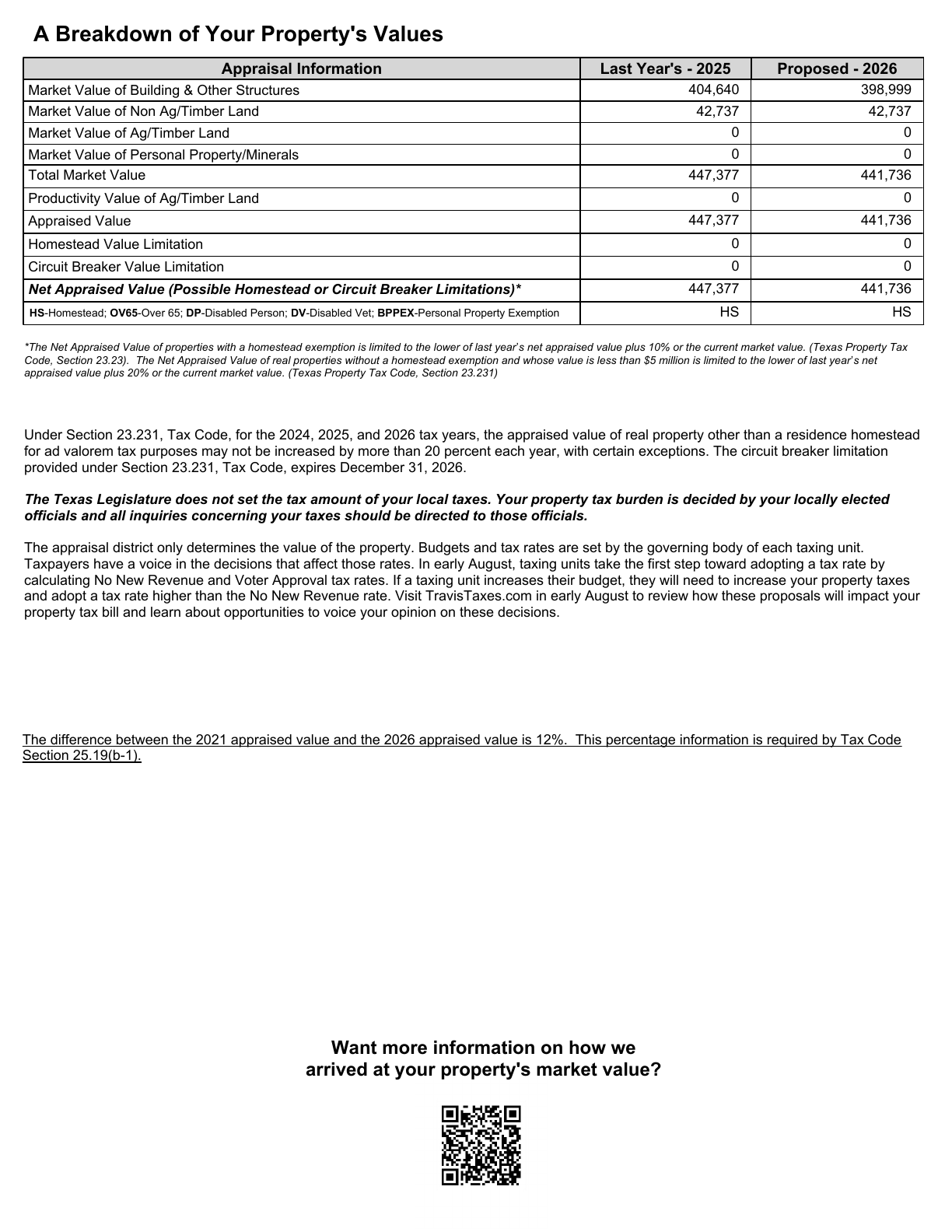
The sample image could not open. Use the numbered field explanations on this page or open sample page 2 on kush.law.

Fields on this page
Select a numbered field to read its explanation.
1. Improvement Value
The structure-side allocation inside the district's total-value model, not a standalone market conclusion proven independently on the notice.
Improvement value usually captures the building and site-improvement portion of the district's total-value conclusion.
Owners frequently overread this line because it feels concrete, but the notice is usually not presenting a separate market for the structure divorced from the land.
The better analytical move is to ask whether the total market value is supportable and whether the allocation itself reveals a modeling problem worth investigating.
- Improvement value is usually a component line, not the end of the analysis.
- A problematic building allocation can still be useful evidence, but it should be tied back to the total-value issue.
- If this line seems wrong, test whether the problem is allocation, condition, or the entire market-value conclusion.
2. Land Value
A component allocation assigned to the land portion of the district's total-value model.
The land line usually reflects how the district allocated its overall value conclusion, not a separate arms-length land-only sale opinion proved on the page.
That makes the figure useful as a modeling clue, but not necessarily as an isolated market conclusion that stands on its own.
If the land line looks implausible, it may indicate a broader problem with the district's total-value model or neighborhood calibration.
- Land value and improvement value should usually be read together.
- A strange land allocation can be evidence of a larger modeling issue.
- The operative valuation dispute still tends to be the total market value outcome.
3. Value Limitation and Why Numbers Differ
When market value and appraised value diverge, the explanation is often statutory rather than arithmetic.
Some properties qualify for a statutory limitation that constrains how far the appraised-value line may move even when market value rises.
When that happens, the notice can show multiple value lines that appear inconsistent at first glance but are actually serving different legal functions.
The correct reading is to identify which line expresses the district's market conclusion and which line reflects the tax-use limit layered on top of it.
- A mismatch is often lawful and expected.
- Value limitations change tax-use numbers without erasing the market-value line.
- Taxable value can still drop further once exemptions are applied.
Sample notice, page 2 · Texas Tax Code § 23.23 · Texas Tax Code § 23.231
Sample notice, page 2 · Texas Tax Code § 23.01 · Texas Tax Code § 23.23 · Texas Tax Code § 23.231
3. Find the filing deadline
Find the date and filing instructions on the notice issued for your property. Calendar that date and check which submission methods your district accepts. The dates on this sample apply only to this example.
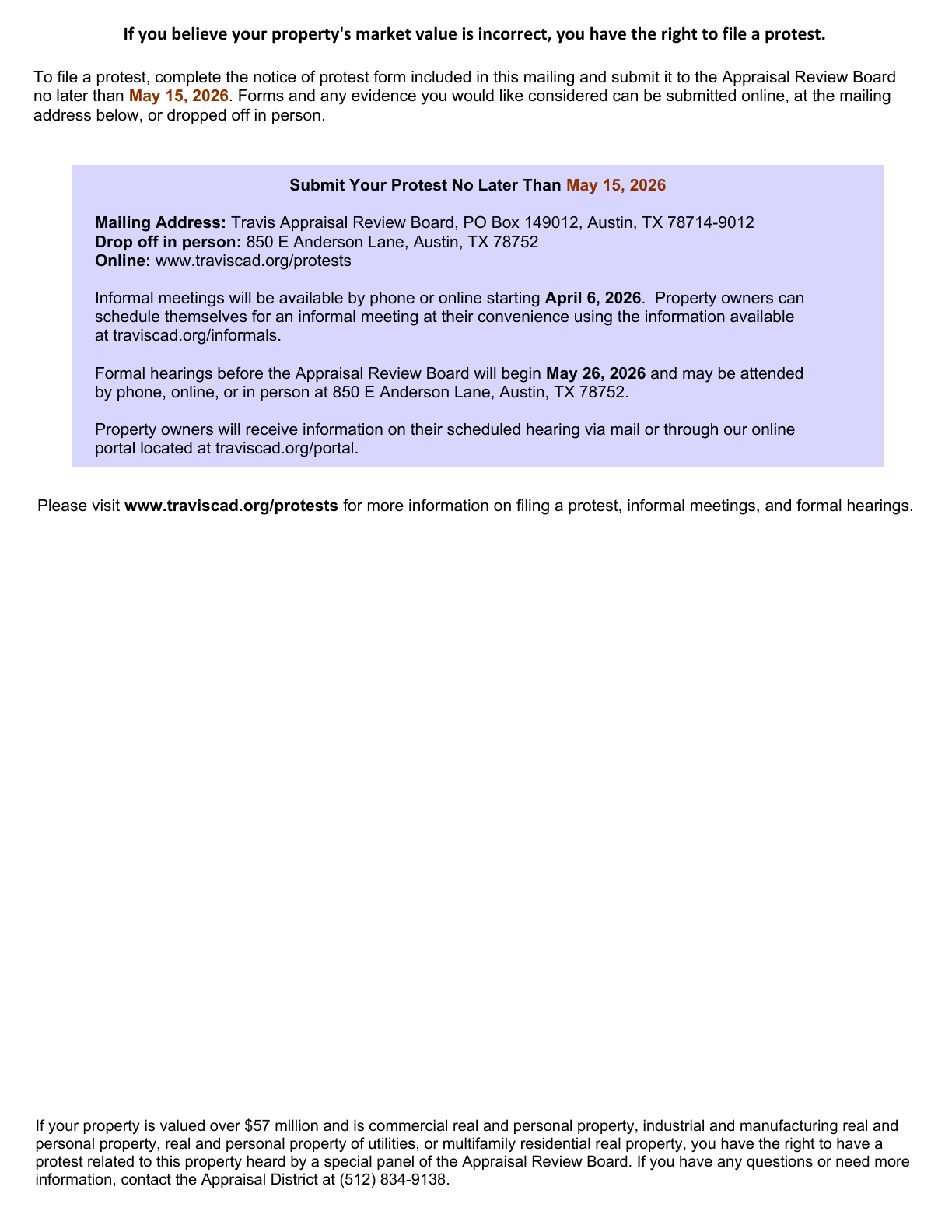
The sample image could not open. Use the numbered field explanations on this page or open sample page 3 on kush.law.

Fields on this page
Select a numbered field to read its explanation.
1. Protest Deadline and Process
The operational page for filing rights, deadlines, and the ordinary protest path.
This page tells the owner when the ordinary protest path closes and which submission routes the district is accepting.
That makes it a process-control page, not merely an informational insert.
Always use the actual date and filing instructions on the notice in hand. Another owner's packet is not a safe substitute.
- Calendar the stated protest date immediately.
- Confirm online, mail, and in-person filing routes before the deadline arrives.
- Do not infer your deadline from a sample packet or a different county notice.
Sample notice, page 3 · Texas Tax Code § 41.44 · Texas Comptroller · Property tax deadlines · Texas Comptroller · Protests and appeals
Sample notice, page 3 · Texas Tax Code § 41.44 · Texas Comptroller · Property tax deadlines · Texas Comptroller · Protests and appeals
4. Decode exemptions
Look up the exemption codes on your notice and compare the entries for each taxing unit. A code can explain why taxable values differ across units.
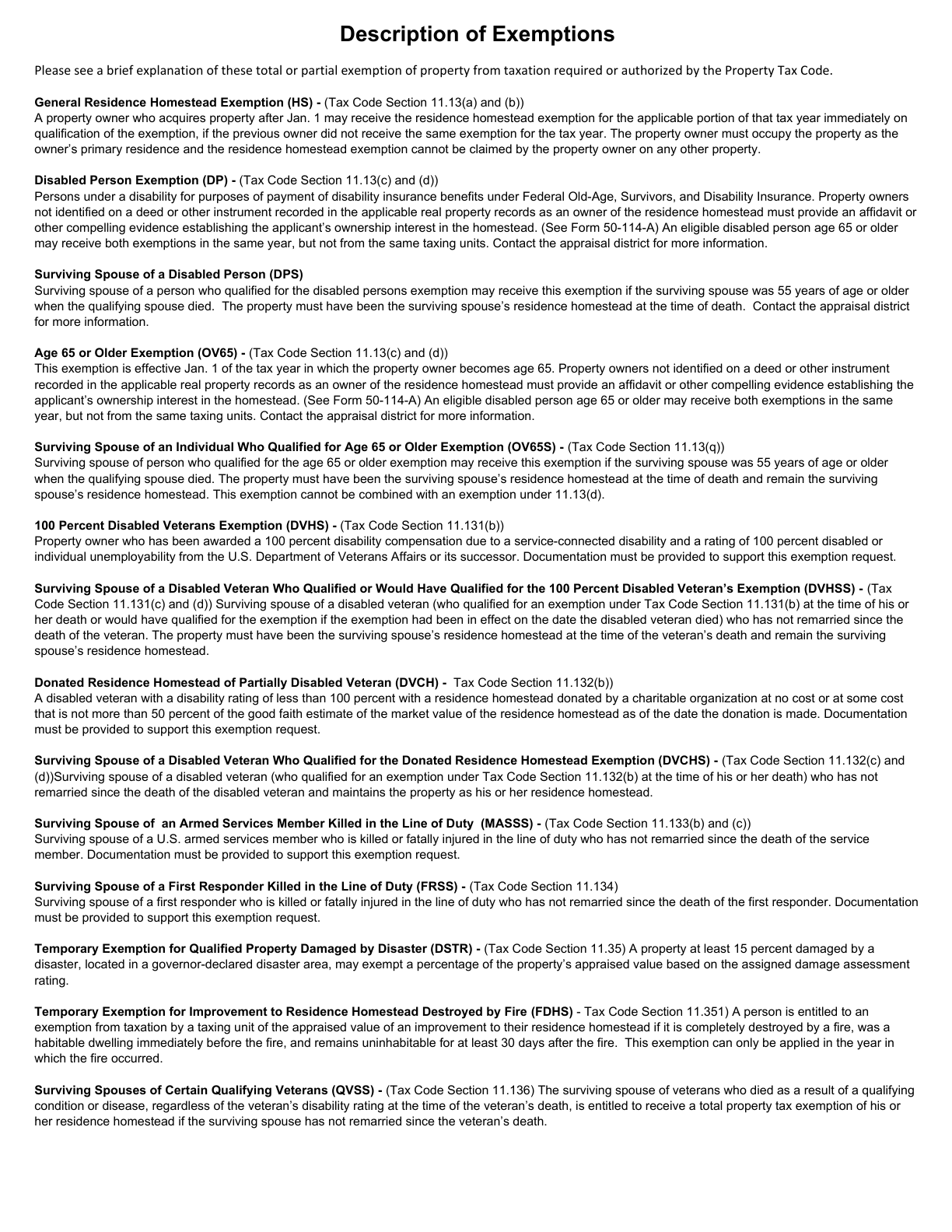
The sample image could not open. Use the numbered field explanations on this page or open sample page 4 on kush.law.

Fields on this page
Select a numbered field to read its explanation.
1. Exemptions
Codes and categories that usually reduce taxable value rather than the headline market value line.
Exemptions appear as legal adjustments that attach to the owner, the property, or both, depending on the rule being applied.
They usually operate on taxable value rather than rewriting the district's headline market value conclusion.
Because exemption eligibility and dollar treatment vary by unit, the same property can display different taxable outcomes across the table.
- Use the exemption page to decode the shorthand on the notice.
- Do not expect exemption language to explain away a market-value dispute.
- Not every exemption category carries across every taxing unit.
Sample notice, page 4 · Texas Tax Code § 11.13 · Texas Comptroller · Property taxpayers’ bill of rights
Sample notice, page 4 · Texas Tax Code § 11.13 · Texas Comptroller · Property taxpayers’ bill of rights
5. Read the process insert
After you identify the issue on your notice, use the taxpayer-assistance material to see how to file a protest and prepare for a hearing. The first four sample pages contain the property-specific information.
Texas Comptroller · Property Taxpayer Remedies · Texas Comptroller · Protests and appeals · Texas Comptroller · Property tax deadlines
6. Review hearing rights
Use the statewide material to understand your rights and the role of the appraisal review board. Return to the first four pages to check your property’s numbers, its exemptions, or the filing instructions.
Texas Comptroller · Property Taxpayer Remedies · Texas Comptroller · Property taxpayers’ bill of rights · Texas Comptroller · Protests and appeals
Preparing a residential protest?
See what makes comparable properties useful and how to document a condition issue.
Read the evidence guide →This is an educational example. Your own notice, filing dates, and property facts govern your matter.